❌

Normal view

Firefox’s AI Kill Switch Lands in Firefox Nightly, Slated for Firefox 148

2 February 2026 at 22:04

Firefox AI Kill Switch

Mozilla has implemented the long-anticipated Firefox AI Kill Switch controls that strips the web browser of any AI-powered features. You can test it right now in Firefox Nightly.

The post Firefox’s AI Kill Switch Lands in Firefox Nightly, Slated for Firefox 148 appeared first on 9to5Linux - do not reproduce this article without permission. This RSS feed is intended for readers, not scrapers.

CentOS 10-20260202.0

2 February 2026 at 19:50
CentOS as a group is a community of open source contributors and users which started in 2003 and has been sponsored by Red Hat since 2014. CentOS Linux versions up to CentOS Linux 8 are 100% compatible rebuilds of Red Hat Enterprise Linux, in full compliance with Red Hat's redistribution requirements. In 2020 it was announced CentOS Linux is being discontinued and replaced with CentOS Stream, a developer-focused distribution which acts as a middle-stream between Fedora and Red Hat Enterprise Linux.

Liya 2.5.1

2 February 2026 at 18:45
Liya Linux is an Arch Linux-based, rolling release distribution. The project uses the Calamares system installer to set up the distribution which offers users the Cinnamon desktop environment, Pamac graphical package manager and OnlyOffice. The system is intended to be easy to use, easy to explore and distraction-free.

Git 2.53 Released with New Features and Performance Improvements

2 February 2026 at 17:50

Git

Git 2.53 open-source distributed version control system is now available for download with new features, new options, and performance improvements.

The post Git 2.53 Released with New Features and Performance Improvements appeared first on 9to5Linux - do not reproduce this article without permission. This RSS feed is intended for readers, not scrapers.

Regata 25.1.0

2 February 2026 at 17:42
Regata OS is a Brazilian Linux distribution based on openSUSE, focusing on desktop and gaming needs. Its main characteristics include a Regata OS store for installing applications and games, out-of-the-box integration with Google Drive, support for a gaming mode via the Vulkan graphics API, an extensive library of games in the Regata OS Game Access portal, support for configuration of hybrid graphics in notebooks, and easy transfer of files between a computer and a smartphone. The distribution's user interface is KDE Plasma.

KDE Linux 20260202

2 February 2026 at 14:04
KDE Linux is a user-focused, general-purpose Linux distribution. It is built by KDE and it is meant to showcase the best implementation of everything KDE has to offer, using the most advanced technologies. The distribution's base packages come from Arch Linux, while everything else is either compiled by the kde-builder tool or included as Flatpak packages. KDE Linux does not come with any traditional package manager, but supports installing Flatpak, Snap or AppImage applications. As it has an immutable base, system updates involve replacing the operating system image with an entirely new one.

MocaccinoOS 26.02

2 February 2026 at 13:02
MocaccinoOS is an independently-developed Linux distribution that has its origins in source-based Gentoo Linux and Sabayon Linux. It uses a custom-built package manager called "Luet", which acts as a front-end for container-based software. The distribution's main features are minimalism and small footprint, ease of use, native vanilla Linux kernels, and support for most important cloud technologies. MocaccinoOS is offered in several variants, including live images with GNOME, KDE Plasma, MATE and Xfce desktops, as well as command-line-only "Minimal Desktop" edition.

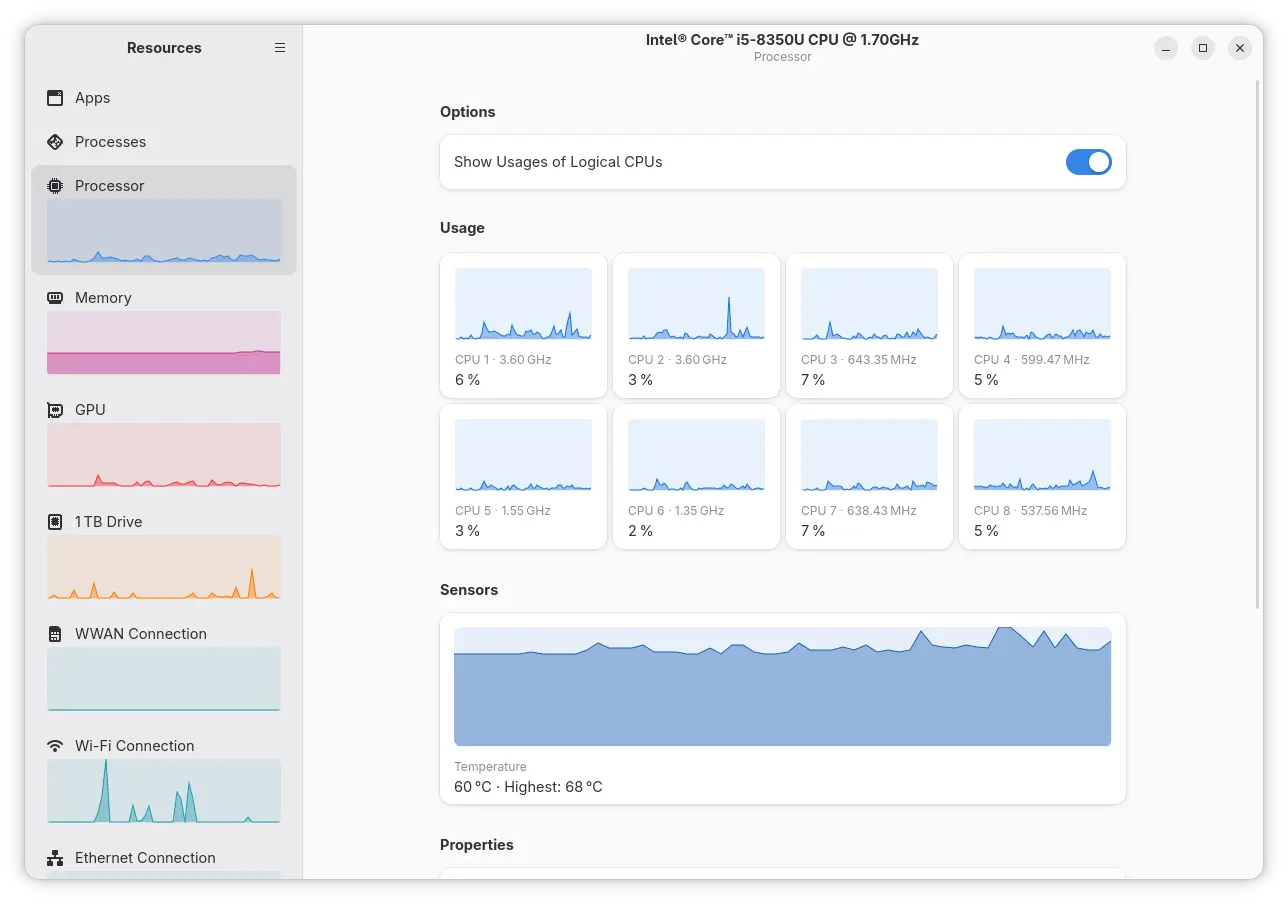
Resources 1.10.0 Released with Monitoring Support for AMD NPU

By: Ji m
2 February 2026 at 12:40

Resources, the system resources and processes monitor that’s default in Ubuntu 26.04, released new 1.10.0 version yesterday.

The new version of this free open-source Rust written application added support for monitoring AMD NPU, the neural processing unit for accelerate AI and machine learning tasks, that found in Ryzen AI 300 / 400 series, Ryzen 7 8700G, Ryzen 5 8600G, and Ryzen 7040/8040 series processors.

Resources has initial NPU support since version 1.7.0 which was for Intel processors only. With the new release, AMD NPU is also supported through the amdxdna driver. Meaning user needs Linux Kernel 6.14 (default in Ubuntu 24.04 with HWE Kernel) or higher for the out-of-the-box support forΒ Ryzen AI NPUs.

You may try modinfo amdxdna command to see if the driver is present in your kernel, and use lsmod | grep amdxdna to see if it’s loaded.

And, load the kernel module either by running sudo modprobe amdxdna command that works until reboot, or by adding to a config file under /etc/modules-load.d/ that works on startup.

Beside AMD NPU, the new version also added support for searching multiple process names using β€œ|” operator. Which is useful when you need to apply operations on multiple processes that are associated.

It also added support for detecting AppImage apps managed by appimaged, which has been deprecated in favor of Go AppImage, as well as detecting apps managed by Portable sandbox and LXC bridge network interfaces for containers.

The new version also changed the way it reads per-process memory usage. Previously, it subtracts shared memory from the memory usage of a process. Now, it reads VmRSS value reported in /proc/<pid>status represents the total amount of physical memory, including the shared memory. So, the app now reports higher per-process memory usage compare to Gnome System Monitor.

Other changes include:

  • Significantly reduce the CPU usage of Resources’ companion process.
  • Improve keyboard navigation for Apps view and Processes view.
  • Fix that column names were not announced to screen readers.
  • And some other fixes and changes.

How to Install Resources

Ubuntu 26.04 (dev release so far) ships with Resources 1.91.0 by default, though not sure if it will upgrade to the new 1.10.0 version in the final release.

For most Linux distributions, the app provides official Flatpak package that runs in sandbox for both modern Intel/AMD and ARM64 (e.g., RasPi and Snapdragon X) processors.

Linux Mint and Fedora (with 3rd party repository enabled) can simply search & install the package from either Software Manager or GNOME Software.

While Debian, Ubuntu, and other Linux may do the steps below one by one to install the package:

  • First, open terminal (Ctrl+Alt+T) and run command to install the Flatpak daemon package:
    sudo apt install flatpak

    For other Linux, follow the official setup guide to enable Flatpak support.

  • Then, run the command below to install the system monitor and task manager app:
    flatpak install https://dl.flathub.org/repo/appstream/net.nokyan.Resources.flatpakref

  • To update the app package, use command:
    flatpak update net.nokyan.Resources

Tips: if the app icon is not visible, try log out and back in, or run last command but replace update with run to start it from terminal.

Uninstall:

To uninstall the Flatpak package, run the command below in terminal:

flatpak uninstall --delete-data net.nokyan.Resources

Also run flatpak uninstall --unused to remove useless runtimes.

NebiOS 10.2-beta

2 February 2026 at 12:01
NebiOS is an Ubuntu-based desktop Linux distribution with a custom Wayland compositor called NebiDE (based on Wayfire). It features various user interface enhancements, an initial setup module called OOBE, the NebiOS App Runtime (napp-runtime) portable application format with bubblewrap containerization, improved gaming performance with Steam Proton integration, a kernel switcher for easy multi-kernel installation, and the Wine compatibility layer for running some Windows applications. NebiOS is intended as a general-purpose operating system for daily computing tasks, including creative work and gaming.

Essora 20260202

2 February 2026 at 11:00
Essora Eos is a set of desktop Linux distributions based either on Debian's "Stable" branch or Devuan, featuring the lightweight JWM or Openbox window managers or the heavyweight KDE Plasma desktop environment. The Devuan edition uses the OpenRC init system. The distribution aims to be clean, minimal, fast and customisable, with only the essential tools installed by default. Essora Eos uses the Calamares system installer and provides a custom graphical configuration utility called "Essora Control Centre".

Slimbook OS 24-r116

2 February 2026 at 10:00
Slimbook OS is an Ubuntu-based Linux distribution customised for the Slimbook line of Linux computers assembled in Spain. It offers a choice of GNOME or KDE Plasma desktops on a single ISO image which also includes some custom extensions and utilities. The distribution provides its own repositories for some software, prioritising DEB and Flatpak packages over Ubuntu's snap options. Some of the other interesting features of Slimbook OS include touchpad gestures (enabled by default), Slimbook service notifications, window tiling, the Terminator terminal emulator, a Ulauncher application for fast searching, and a day/night mode switcher.

d77void 20260202

2 February 2026 at 09:03
d77void GNU/Linux is a Void-based Linux distribution created to demonstrate the capabilities of Void's tools, such as void-mklive and void-packages. Originally initiated as a Void respin with the Fluxbox window manager, the project has evolved to offer a wide range of window manager, Wayland compositor and desktop environment options, including Awesome, bspwm, COSMIC, dwm, Fluxbox, herbstluftwm, Hyprland, i3wm, JWM, labwc, LeftWM, LXQt, Niri, Openbox, Qtile, River, Sway, Wayfire and Xfce. The distribution can be installed to a hard disc with the text-mode d77void-installer.

Expirion 6.3-260202

2 February 2026 at 08:09
Expirion Linux is a Devuan-based desktop distribution which offers LXQt and Xfce desktop editions. The project provides separate releases built from the latest "stable" and "testing" branches of Devuan, with runit and SysV as init system options. Expirion ships with a more recent kernel than Devuan does and it also adds some user-friendly touches, custom themes and wallpapers, as well as productivity applications, such as LibreOffice, Chromium, Firefox, Thunderbird, Audacity, Brasero and VLC.

9to5Linux Weekly Roundup: February 1st, 2026

2 February 2026 at 06:09

9to5Linux Roundup February 1st

9to5Linux Weekly Roundup for February 1st, 2026, brings news about GParted 1.8, Transmission 4.1, GStreamer 1.28, OpenSSL 3.6.1, Proton 10.0-4, GParted Live 1.8, VirtualBox 7.2.6, Calibre 9.0, Tails 7.4.1, AerynOS 2026.01, Linux Lite 7.8, Shotcut 26.1, TigerVNC 1.16, and more.

The post 9to5Linux Weekly Roundup: February 1st, 2026 appeared first on 9to5Linux - do not reproduce this article without permission. This RSS feed is intended for readers, not scrapers.

Gentoo 20260201

1 February 2026 at 23:46
Gentoo Linux is a versatile and fast, completely free Linux distribution geared towards developers and network professionals. Unlike other distros, Gentoo Linux has an advanced package management system called Portage. Portage is a true ports system in the tradition of BSD ports, but is Python-based and sports a number of advanced features including dependencies, fine-grained package management, "fake" (OpenBSD-style) installs, safe unmerging, system profiles, virtual packages, config file management, and more.

LinuxHub 2026.02.01

1 February 2026 at 22:51
LinuxHub Prime is an Arch-based Linux distribution with a customised Openbox window manager as the default desktop environment. Its main feature is a unique installer that provides one-click installation options for several popular window managers and desktop environments, including Awesome, bspwm, Budgie, Cinnamon, Deepin, GNOME, Hyprland, KDE Plasma, MATE, Qtile and Xfce. The installer also includes "Prime Builder", a tool for creating a custom respin of the distribution.

Senpai 20260201

1 February 2026 at 21:41
Senpai Respins is a set of (principally) MX Linux respins with Cinnamon, GNOME, LXDE, LXQT, MATE and Moksha desktops and window managers, user interfaces that the upstream project does not offer. It also provides a respin of Linux Mint Debian Edition (LMDE) with MATE, and MX Linux with the Parrot distribution installed on top of it. The MX Linux variants offer a choice between the systemd and SysV init systems. Other than integrating a new desktop into an existing distribution, Senpai brings very few other modifications, leaving the software composition and visual appearance of the upstream project intact.
❌